A Horses B Silk C China Dishware D Spices Incorrect Please Try Again

The spice trade involved historical civilizations in Asia, Northeast Africa and Europe. Spices such as cinnamon, cassia, cardamom, ginger, pepper, nutmeg, star anise, clove and turmeric were known and used in antiquity and traded in the Eastern Globe.[i] These spices institute their way into the Virtually East before the beginning of the Christian era, with fantastic tales hiding their true sources.[1]
The maritime aspect of the trade was dominated by the Austronesian peoples in Southeast Asia, namely the ancient Indonesian sailors which established routes from Southeast Asia to Sri Lanka and India (and later China) by 1500 BC.[2] These goods were and so transported by land towards the Mediterranean and the Greco-Roman world via the incense route and the Roman–India routes past Indian and Persian traders.[three] The Austronesian maritime trade lanes later expanded into the Heart East and eastern Africa by the 1st millennium AD, resulting in the Austronesian colonization of Madagascar.
Within specific regions, the Kingdom of Axum (fifth century BC–Advertizing 11th century) had pioneered the Carmine Sea route before the 1st century AD. During the first millennium AD, Ethiopians became the maritime trading power of the Red Body of water. By this catamenia, trade routes existed from Sri Lanka (the Roman Taprobane) and Bharat, which had acquired maritime technology from early Austronesian contact. By mid-7th century Ad, after the rise of Islam, Arab traders started plying these maritime routes and dominated the western Indian Ocean maritime routes.[ citation needed ]
Arab traders eventually took over conveying appurtenances via the Levant and Venetian merchants to Europe until the rising of the Seljuk Turks in 1090. Later the Ottoman Turks held the road once again by 1453 respectively. Overland routes helped the spice trade initially, just maritime trade routes led to tremendous growth in commercial activities to Europe.[ citation needed ]
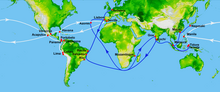
The trade was changed by the Crusades and later the European Age of Discovery,[4] during which the spice trade, particularly in blackness pepper, became an influential activity for European traders.[five] From the 11th to the 15th centuries, the Italian maritime republics of Venice and Genoa monopolized the trade between Europe and Asia.[6] The Greatcoat Route from Europe to the Indian Body of water via the Cape of Good Hope was pioneered past the Portuguese explorer navigator Vasco da Gama in 1498, resulting in new maritime routes for merchandise.[7]
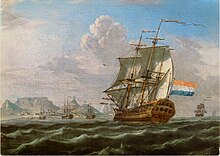
This trade, which drove world trade from the end of the Eye Ages well into the Renaissance,[five] ushered in an age of European domination in the East.[7] Channels such equally the Bay of Bengal served every bit bridges for cultural and commercial exchanges between diverse cultures[4] as nations struggled to gain control of the trade forth the many spice routes.[1] In 1571 the Castilian opened the first trans-Pacific road betwixt its territories of the Philippines and United mexican states, served past the Manila Galleon. This trade route lasted until 1815. The Portuguese trade routes were mainly restricted and express by the use of ancient routes, ports, and nations that were hard to dominate. The Dutch were after able to bypass many of these issues past pioneering a directly ocean route from the Cape of Expert Hope to the Sunda Strait in Indonesia.
Origins [edit]

People from the Neolithic period traded in spices, obsidian, body of water shells, precious stones and other high-value materials every bit early on as the 10th millennium BC. The commencement to mention the merchandise in historical periods are the Egyptians. In the third millennium BC, they traded with the Land of Punt, which is believed to have been situated in an area encompassing northern Somalia, Republic of djibouti, Eritrea and the Cerise Body of water coast of Sudan.[viii] [nine]
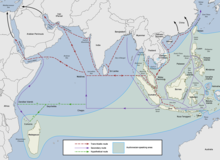

The spice trade was associated with overland routes early on, but maritime routes proved to be the cistron which helped the merchandise grow.[1] The first true maritime trade network in the Indian Bounding main was past the Austronesian peoples of Island Southeast Asia,[x] who built the offset ocean-going ships.[11] They established trade routes with Southern Republic of india and Sri Lanka as early on equally 1500 BC, ushering an exchange of material culture (similar catamarans, outrigger boats, lashed-lug and sewn-plank boats, and paan) and cultigens (like coconuts, sandalwood, bananas, and sugarcane), also as connecting the material cultures of India and China. Indonesians in particular were trading in spices (mainly cinnamon and cassia) with East Africa using catamaran and outrigger boats and sailing with the help of the westerlies in the Indian Ocean. This trade network expanded to achieve as far every bit Africa and the Arabian Peninsula, resulting in the Austronesian colonization of Madagascar by the first one-half of the offset millennium AD. It connected into historic times, subsequently becoming the Maritime Silk Road.[10] [12] [13] [14] [15]
In the first millennium BC the Arabs, Phoenicians, and Indians were too engaged in body of water and land trade in luxury goods such as spices, gold, precious stones, leather of exotic animals, ebony and pearls. The bounding main trade was in the Ruby-red Bounding main and the Indian Sea. The bounding main route in the Red Body of water was from Bab-el-Mandeb to Berenike, from there past country to the Nile, and and so by boats to Alexandria. Luxury goods including Indian spices, ebony, silk and fine textiles were traded along the overland incense route.[1]
In the 2nd one-half of the first millennium BC the Arab tribes of South and West Arabia took control over the state trade of spices from South Arabia to the Mediterranean Ocean. These tribes were the M'own, Qataban, Hadhramaut, Saba and Himyarite. In the n the Nabateans took command of the trade route that crossed the Negev from Petra to Gaza. The merchandise enriched these tribes. South Arabia was chosen Eudaemon Arabia (the elated Arabia) by the Greeks and was on the agenda of conquests of Alexander of Macedonia before he died. The Indians and the Arabs had control over the ocean trade with India. In the late 2d century BC, the Greeks from the Ptolemaic dynasty of Egypt learned from the Indians how to sail directly from Aden to the w coast of Bharat using the monsoon winds (as did Hippalus) and took control of the sea merchandise via Red Sea ports.[16]
Spices are discussed in biblical narratives, and there is literary show for their employ in ancient Greek and Roman society. There is a record from Tamil texts of Greeks purchasing large sacks of black pepper from India, and many recipes in the 1st-century Roman cookbook Apicius make employ of the spice. The trade in spices lessened after the fall of the Roman Empire, but need for ginger, black pepper, cloves, cinnamon and nutmeg revived the trade in later centuries.[17]
Arab merchandise and medieval Europe [edit]

Merchandise road in the Reddish Bounding main linking Italy to south-west India
Rome played a part in the spice trade during the fifth century, but this function, unlike the Arabian i, did non concluding through the Center Ages.[1] The rise of Islam brought a significant modify to the trade as Radhanite Jewish and Arab merchants, particularly from Egypt, eventually took over conveying goods via the Levant to Europe. At times, Jews enjoyed a virtual monopoly on the spice trade in large parts of Western Europe.[18]
The spice trade had brought great riches to the Abbasid Caliphate and inspired famous legends such as that of Sinbad the Sailor. These early sailors and merchants would oft set sail from the port city of Basra and, after many ports of phone call, would return to sell their goods, including spices, in Baghdad. The fame of many spices such every bit nutmeg and cinnamon are attributed to these early spice merchants.[xix] [ failed verification ]
The Indian commercial connection with South E Asia proved vital to the merchants of Arabia and Persia during the 7th and 8th centuries.[twenty] Arab traders — mainly descendants of sailors from Yemen and Oman — dominated maritime routes throughout the Indian Sea, borer source regions in the Far East and linking to the surreptitious "spice islands" (Maluku Islands and Banda Islands). The islands of Molucca also find mention in several records: a Javanese relate (1365) mentions the Moluccas and Maloko,[21] and navigational works of the 14th and 15th centuries comprise the first unequivocal Arab reference to Moluccas.[21] Sulaima al-Mahr writes: "East of Timor [where sandalwood is establish] are the islands of Bandam and they are the islands where nutmeg and mace are establish. The islands of cloves are chosen Maluku ....."[21]
Moluccan products were shipped to trading emporiums in India, passing through ports like Kozhikode in Kerala and through Sri Lanka.[22] From in that location they were shipped westward across the ports of Arabia to the Virtually Due east, to Ormus in the Persian Gulf and Jeddah in the Crimson Sea and sometimes to East Africa, where they were used for many purposes, including burial rites.[22] The Abbasids used Alexandria, Damietta, Aden and Siraf equally entry ports to trade with India and Red china.[23] Merchants arriving from Bharat in the port city of Aden paid tribute in form of musk, camphor, ambergris and sandalwood to Ibn Ziyad, the sultan of Yemen.[23]
Indian spice exports find mention in the works of Ibn Khurdadhbeh (850), al-Ghafiqi (1150), Ishak bin Imaran (907) and Al Kalkashandi (14th century).[22] Chinese traveler Xuanzang mentions the town of Puri where "merchants depart for distant countries."[24]

From in that location, overland routes led to the Mediterranean coasts. From the 8th until the 15th century, maritime republics (Republic of Venice, Republic of Pisa, Republic of Genoa, Duchy of Amalfi, Duchy of Gaeta, Republic of Ancona and Republic of Ragusa[25]) held a monopoly on European trade with the Middle E. The silk and spice trade, involving spices, incense, herbs, drugs and opium, fabricated these Mediterranean metropolis-states extremely wealthy. Spices were among the most expensive and in-demand products of the Middle Ages, used in medicine as well as in the kitchen. They were all imported from Asia and Africa. Venetian and other navigators of maritime republics and then distributed the goods through Europe.
The Ottoman Empire, after the fall of Constantinople in 1453, barred Europeans from important combined state-sea routes.[26]
Age of Discovery: a new route and a New World [edit]
The Republic of Venice had become a formidable power and a key thespian in the Eastern spice trade.[27] Other powers, in an endeavor to break the Venetian agree on spice merchandise, began to build up maritime adequacy.[1] Until the mid-15th century, trade with the Due east was accomplished through the Silk Road, with the Byzantine Empire and the Italian urban center-states of Venice and Genoa acting equally middlemen.
In 1453, notwithstanding, the Ottoman Empire took control of the sole spice trade route that existed at the fourth dimension afterwards the fall of Constantinople, and were in a favorable position to charge hefty taxes on merchandise bound for the w. The Western Europeans,[ which? ] not wanting to be dependent on an expansionist, non-Christian ability for the lucrative commerce with the E, set out to find an alternative route by sea around Africa.[ citation needed ]
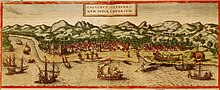
The offset state to effort to circumnavigate Africa was Portugal, which had, since the early 15th century, begun to explore northern Africa nether Henry the Navigator. Emboldened by these early on successes and eyeing a lucrative monopoly on a possible sea route to the Indies, the Portuguese starting time rounded the Cape of Good Promise in 1488 on an expedition led past Bartolomeu Dias.[28] But ix years later in 1497, on the orders of Manuel I of Portugal, four vessels nether the command of navigator Vasco da Gama continued beyond to the eastern coast of Africa to Malindi and sailed across the Indian Ocean to Calicut, on the Malabar Declension in Kerala[7] in Due south India — the capital of the local Zamorin rulers. The wealth of the Indies was now open for the Europeans to explore; the Portuguese Empire was the earliest European seaborne empire to grow from the spice trade.[7]
In 1511, Afonso de Albuquerque conquered Malacca for Portugal, then the heart of Asian merchandise. East of Malacca, Albuquerque sent several diplomatic and exploratory missions, including to the Moluccas. Learning the hush-hush location of the Spice Islands, mainly the Banda Islands, then the world source of nutmeg, he sent an trek led by António de Abreu to Banda, where they were the kickoff Europeans to arrive, in early 1512.[29] Abreu's expedition reached Buru, Ambon and Seram Islands, and so Banda.
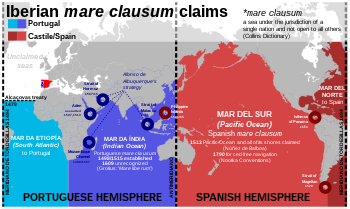
From 1507 to 1515 Albuquerque tried to completely block Arab and other traditional routes that stretched from the shores of Western Pacific to the Mediterranean Sea, through the conquest of strategic bases in the Persian Gulf and at the entry of the Red Sea.[ citation needed ]
By the early on 16th century the Portuguese had complete control of the African sea route, which extended through a long network of routes that linked three oceans, from the Moluccas (the Spice Islands) in the Pacific Ocean limits, through Malacca, Kerala and Sri Lanka, to Lisbon in Portugal.[ citation needed ]
The Crown of Castile had organized the expedition of Christopher Columbus to compete with Portugal for the spice trade with Asia, but when Columbus landed on the island of Hispaniola (in what is now Haiti) instead of in the Indies, the search for a route to Asia was postponed until a few years later. After Vasco Núñez de Balboa crossed the Isthmus of Panama in 1513, the Spanish Crown prepared a westward voyage by Ferdinand Magellan in order to accomplish Asia from Spain beyond the Atlantic and Pacific Oceans. On October 21, 1520, his expedition crossed the Strait of Magellan in the southern tip of Southward America, opening the Pacific to European exploration. On March 16, 1521, the ships reached the Philippines and shortly subsequently the Spice Islands, ultimately resulting decades afterwards in the Manila Galleon trade, the get-go w spice trade road to Asia. After Magellan's death in the Philippines, navigator Juan Sebastian Elcano took command of the trek and drove it beyond the Indian Ocean and back to Kingdom of spain, where they arrived in 1522 aboard the last remaining ship, the Victoria. For the next 2-and-a-half centuries, Spain controlled a vast trade network that linked 3 continents: Asia, the Americas and Europe. A global spice route had been created: from Manila in the Philippines (Asia) to Seville in Kingdom of spain (Europe), via Acapulco in United mexican states (North America).[ commendation needed ]
Cultural diffusion [edit]
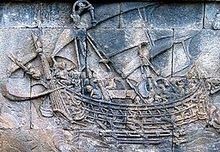
One of the most important technological exchanges of the spice trade network was the early introduction of maritime technologies to India, the Eye East, East Africa, and Red china by the Austronesian peoples. These technologies include the plank-sewn hulls, catamarans, outrigger boats, and possibly the lateen sail. This is still evident in Sri Lankan and South Indian languages. For instance, Tamil paṭavu, Telugu paḍava, and Kannada paḍahu, all meaning "ship", are all derived from Proto-Hesperonesian *padaw, "sailboat", with Austronesian cognates like Javanese perahu, Kadazan padau, Maranao padaw, Cebuano paráw, Samoan folau, Hawaiian halau, and Māori wharau.[13] [12] [14]
Austronesians also introduced many Austronesian cultigens to southern Bharat, Sri Lanka, and eastern Africa that figured prominently in the spice trade.[30] They include bananas,[31] Pacific domesticated coconuts,[32] [33] Dioscorea yams,[34] wetland rice,[31] sandalwood,[35] giant taro,[36] Polynesian arrowroot,[37] ginger,[38] lengkuas,[xxx] tailed pepper,[39] betel,[40] areca nut,[xl] and sugarcane.[41] [42]
Hindu and Buddhist religious establishments of Southeast Asia came to be associated with economic activeness and commerce every bit patrons, entrusted large funds which would afterward be used to do good local economies by manor management, craftsmanship, and promotion of trading activities.[43] Buddhism, in detail, traveled alongside the maritime trade, promoting coinage, art, and literacy.[44] Islam spread throughout the E, reaching maritime Southeast Asia in the 10th century; Muslim merchants played a crucial part in the trade.[45] Christian missionaries, such as Saint Francis Xavier, were instrumental in the spread of Christianity in the East.[45] Christianity competed with Islam to become the dominant religion of the Moluccas.[45] Still, the natives of the Spice Islands accommodated to aspects of both religions easily.[46]
The Portuguese colonial settlements saw traders such as the Gujarati banias, South Indian Chettis, Syrian Christians, Chinese from Fujian province, and Arabs from Aden involved in the spice merchandise.[47] Epics, languages, and cultural customs were borrowed past Southeast Asia from India, and later People's republic of china.[4] Knowledge of Portuguese language became essential for merchants involved in the trade.[48] The colonial pepper trade drastically changed the experience of modernity in Europe, and in Kerala and information technology brought, along with colonialism, early capitalism to India's Malabar Coast, changing cultures of work and caste.[49]
Indian merchants involved in spice merchandise took Indian cuisine to Southeast Asia, notably nowadays mean solar day Malaysia and Indonesia, where spice mixtures and black pepper became popular.[50] Conversely, Southeast Asian cuisine and crops was as well introduced to India and Sri Lanka, where rice cakes and kokosnoot milk-based dishes are yet dominant.[thirty] [32] [31] [38] [51]
European people intermarried with Indians and popularized valuable culinary skills, such as baking, in India.[52] Indian food, adapted to the European palate, became visible in England by 1811 as exclusive establishments began catering to the tastes of both the curious and those returning from India.[53] Opium was a part of the spice trade, and some people involved in the spice trade were driven by opium habit.[54] [55]
Encounter also [edit]
- Silk Route
- East Indies
-
 Food portal
Bibliography [edit]
- Collingham, Lizzie (December 2005). Curry: A Tale of Cooks and Conquerors. Oxford University Press. ISBN978-0195172416.
- Corn, Charles; Debbie Glasserman (March 1999). The Scents of Eden: A History of the Spice Trade. Kodansha America. ISBN978-1568362496.
- Donkin, Robin A. (August 2003). Between East and West: The Moluccas and the Traffic in Spices Up to the Arrival of Europeans. Diane Publishing Company. ISBN978-0871692481.
- Fage, John Donnelly; et al. (1975). The Cambridge History of Africa . Cambridge Academy Press. ISBN978-0521215923.
- Rawlinson, Hugh George (2001). Intercourse Between Bharat and the Western Earth: From the Primeval Times of the Fall of Rome. Asian Educational Services. ISBN978-8120615496.
- Shaw, Ian (2003). The Oxford History of Aboriginal Egypt. Oxford Academy Press. ISBN978-0192804587.
- Kalidasan, Vinod Kottayil (2015). "Routes of Pepper: Colonial Discourses effectually Spice Trade in Malabar" in Kerala Modernity: Ideas, Spaces and Practices in Transition, Shiju Sam Varughese and Sathese Chandra Bose (Eds). Orient Blackswan, New Delhi. ISBN978-81-250-5722-2.
References [edit]
- ^ a b c d e f g "Spice Trade". Encyclopædia Britannica. 2016. Retrieved 25 April 2016.
- ^ Dick-Read, Robert (July 2006). "Indonesia and Africa: questioning the origins of some of Africa's virtually famous icons". The Periodical for Transdisciplinary Inquiry in Southern Africa. ii (1): 23–45. doi:10.4102/td.v2i1.307.
- ^ Fage 1975: 164
- ^ a b c Donkin 2003
- ^ a b Corn & Glasserman 1999: Prologue
- ^ "Erudite IAS - Online & Offline Classes". Brainy IAS. 2018-03-03. Retrieved 2021-09-22 .
- ^ a b c d Gama, Vasco da. The Columbia Encyclopedia, Sixth Edition. Columbia University Press.
- ^ Simson Najovits, Arab republic of egypt, torso of the tree, Volume 2, (Algora Publishing: 2004), p. 258.
- ^ Rawlinson 2001: 11-12
- ^ a b c Manguin, Pierre-Yves (2016). "Austronesian Shipping in the Indian Sea: From Outrigger Boats to Trading Ships". In Campbell, Gwyn (ed.). Early Exchange between Africa and the Wider Indian Body of water World. Palgrave Macmillan. pp. 51–76. ISBN9783319338224.
- ^ Meacham, Steve (11 December 2008). "Austronesians were first to sail the seas". The Sydney Morning Herald . Retrieved 28 April 2019.
- ^ a b Doran, Edwin, Jr. (1974). "Outrigger Ages". The Periodical of the Polynesian Society. 83 (2): 130–140.
- ^ a b Mahdi, Waruno (1999). "The Dispersal of Austronesian gunkhole forms in the Indian Ocean". In Cringe, Roger; Spriggs, Matthew (eds.). Archaeology and Language III: Artefacts languages, and texts. One World Archaeology. Vol. 34. Routledge. pp. 144–179. ISBN0415100542. [ dead link ]
- ^ a b Doran, Edwin B. (1981). Wangka: Austronesian Canoe Origins. Texas A&Thou Academy Press. ISBN9780890961070.
- ^ Cringe, Roger (2004). "Fruits and arboriculture in the Indo-Pacific region". Message of the Indo-Pacific Prehistory Clan. 24 (The Taipei Papers (Volume 2)): 31–l.
- ^ Shaw 2003: 426
- ^ The Medieval Spice Merchandise and the Diffusion of the Chile Gastronomica Spring 2007 Vol. 7 Upshot 2
- ^ Rabinowitz, Louis (1948). Jewish Merchant Adventurers: A Written report of the Radanites. London: Edward Goldston. pp. 150–212.
- ^ "The Tertiary Voyage of Sindbad the Seaman – The Arabian Nights – The Thousand and I Nights – Sir Richard Burton translator". Classiclit.near.com. 2009-11-02. Retrieved 2011-09-16 .
- ^ Donkin 2003: 59
- ^ a b c Donkin 2003: 88
- ^ a b c Donkin 2003: 92
- ^ a b Donkin 2003: 91–92
- ^ Donkin 2003: 65
- ^ Armando Lodolini, Le repubbliche del mare, Roma, Biblioteca di storia patria, 1967.
- ^ "International School History - MYP History". www.internationalschoolhistory.net . Retrieved 2020-05-25 .
- ^ Pollmer, Priv.Doz. Dr. Udo. "The spice trade and its importance for European expansion". Migration and Diffusion . Retrieved 27 June 2016.
- ^ Catholic Encyclopedia: Bartolomeu Dias Retrieved November 29, 2007
- ^ Nathaniel's Nutmeg: How One Man's Backbone Changed the Grade of History, Milton, Giles (1999), pp. 5–seven
- ^ a b c Hoogervorst, Tom (2013). "If Only Plants Could talk...: Reconstructing Pre-Modern Biological Translocations in the Indian Ocean" (PDF). In Chandra, Satish; Prabha Ray, Himanshu (eds.). The Sea, Identity and History: From the Bay of Bengal to the South China Sea. Manohar. pp. 67–92. ISBN9788173049866.
- ^ a b c Lockard, Craig A. (2010). Societies, Networks, and Transitions: A Global History. Cengage Learning. pp. 123–125. ISBN9781439085202.
- ^ a b
- ^ Crowther, Alison; Lucas, Leilani; Helm, Richard; Horton, Mark; Shipton, Ceri; Wright, Henry T.; Walshaw, Sarah; Pawlowicz, Matthew; Radimilahy, Chantal; Douka, Katerina; Picornell-Gelabert, Llorenç; Fuller, Dorian Q.; Boivin, Nicole L. (fourteen June 2016). "Ancient crops provide kickoff archaeological signature of the westward Austronesian expansion". Proceedings of the National Academy of Sciences. 113 (24): 6635–6640. doi:ten.1073/pnas.1522714113. PMC4914162. PMID 27247383.
- ^ Barker, Graeme; Hunt, Chris; Barton, Huw; Gosden, Chris; Jones, Sam; Lloyd-Smith, Lindsay; Farr, Lucy; Nyirí, Borbala; O'Donnell, Shawn (Baronial 2017). "The 'cultured rainforests' of Borneo" (PDF). Quaternary International. 448: 44–61. Bibcode:2017QuInt.448...44B. doi:x.1016/j.quaint.2016.08.018.
- ^ Play tricks, James J. (2006). Inside Austronesian Houses: Perspectives on Domestic Designs for Living. ANU Due east Printing. p. 21. ISBN9781920942847.
- ^ Matthews, Peter J. (1995). "Aroids and the Austronesians". Torrid zone. 4 (2/3): 105–126. doi:10.3759/torrid zone.4.105.
- ^ Spennemann, Dirk H.R. (1994). "Traditional Arrowroot Product and Utilization in the Republic of the marshall islands". Journal of Ethnobiology. 14 (2): 211–234.
- ^ a b Viestad A (2007). Where Flavor Was Born: Recipes and Culinary Travels Along the Indian Ocean Spice Route. San Francisco: Chronicle Books. p. 89. ISBN9780811849654.
- ^ Ravindran, P.Due north. (2017). The Encyclopedia of Herbs and Spices. CABI. ISBN9781780643151.
- ^ a b Zumbroich, Thomas J. (2007–2008). "The origin and diffusion of betel chewing: a synthesis of testify from Southern asia, Southeast Asia and beyond". eJournal of Indian Medicine. ane: 87–140.
- ^ Daniels, John; Daniels, Christian (April 1993). "Sugarcane in Prehistory". Archaeology in Oceania. 28 (ane): 1–7. doi:ten.1002/j.1834-4453.1993.tb00309.x.
- ^ Paterson, Andrew H.; Moore, Paul H.; Tom Fifty., Tew (2012). "The Gene Pool of Saccharum Species and Their Improvement". In Paterson, Andrew H. (ed.). Genomics of the Saccharinae. Springer Scientific discipline & Business Media. pp. 43–72. ISBN9781441959478.
- ^ Donkin 2003: 67
- ^ Donkin 2003: 69
- ^ a b c Corn & Glasserman 1999
- ^ Corn & Glasserman 1999: 105
- ^ Collingham 56: 2006
- ^ Corn & Glasserman 1999: 203
- ^ Vinod Kottayil Kalidasan, 'The Routes of Pepper: Colonial Discourses around the Spice Merchandise in Malabar', Kerala Modernity: Ideasa, Spaces and Practices in Transition, Ed. Shiju Sam Varughese and Satheese Chandra Bose, New Delhi: Orient Blackswan, 2015. For the link: "Archived copy". Archived from the original on 2015-04-13. Retrieved 2015-04-13 .
{{cite web}}: CS1 maint: archived copy as title (link) - ^ Collingham 245: 2006
- ^ Dalby A (2002). Dangerous Tastes: The Story of Spices. Academy of California Press. ISBN9780520236745.
- ^ Collingham 61: 2006
- ^ Collingham 129: 2006
- ^ "Opium Throughout History | The Opium Kings | FRONTLINE | PBS". www.pbs.org . Retrieved 2018-04-13 .
- ^ Burger, Thousand. (2003), The Forgotten Gold? The Importance of the Dutch opium trade in the Seventeenth Century
Further reading [edit]
- Borschberg, Peter (2017), 'The Value of Admiral Matelieff's Writings for Studying the History of Southeast Asia, c. 1600–1620,'. Journal of Southeast Asian Studies 48(iii): 414–435. doi:10.1017/S002246341700056X
- Nabhan, Gary Paul: Cumin, Camels, and Caravans: A Spice Odyssey. [History of Spice Trade] University of California Press, 2014. ISBN 978-0-520-26720-6 [Print]; ISBN 978-0-520-95695-seven [eBook]
- Pavo López, Marcos: Spices in maps. Fifth centenary of the kickoff circumnavigation of the globe. [History of the spice trade through old maps] east-Perimetron, vol fifteen, no.2 (2020)
External links [edit]
 Media related to Spice trade at Wikimedia Commons
- The Spice Trade and the Age of Exploration
- Merchandise between the Romans and the Empires of Asia. Department of Aboriginal Near Eastern Art, The Metropolitan Museum of Art
- The Spice Trade and its importance for European Expansion, Doz. Udo Pollmer
Source: https://en.wikipedia.org/wiki/Spice_trade
0 Response to "A Horses B Silk C China Dishware D Spices Incorrect Please Try Again"
Post a Comment